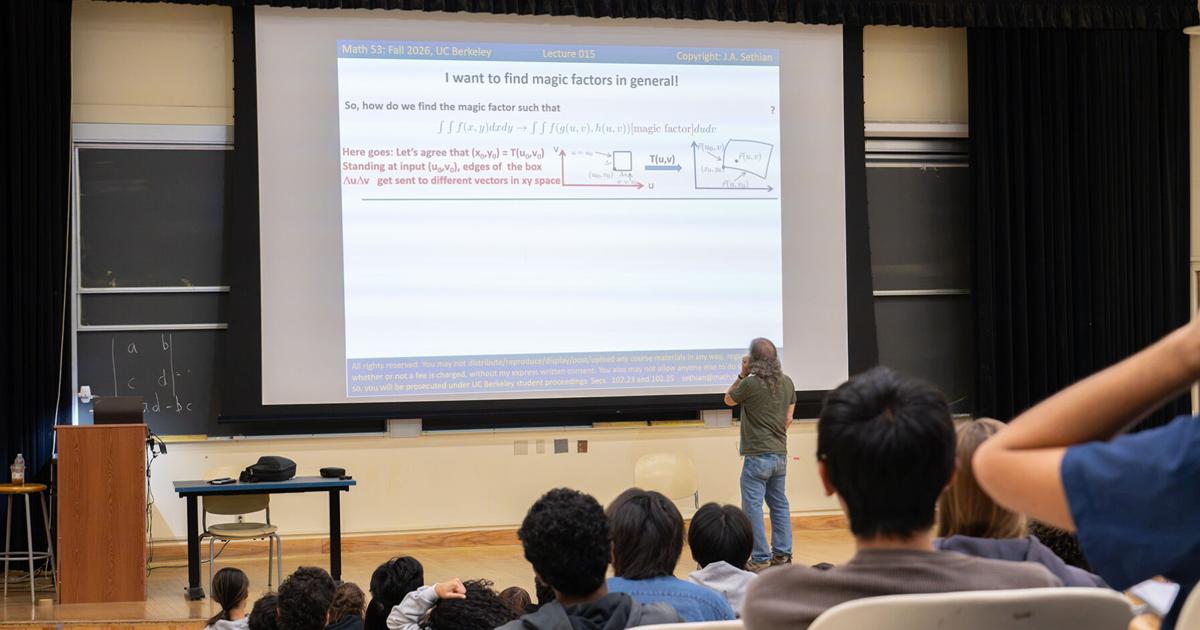
Richard Borcherds, a UC Berkeley mathematics professor and Fields medalist, no longer grades his students' homework. After seeing how many students used AI to consistently earn top scores, he concluded there was "no point" in paying graders to check homework for correctness, according to an interview Tuesday with the Daily Californian.
Borcherds now grades on completion instead of accuracy when a student submits homework. He admitted this is "not a very good system," but said he has no alternative at the moment. His decision came shortly after OpenAI announced that AI agents apparently solved the Navier-Stokes existence and smoothness problem, one of mathematics' most difficult unsolved problems.
UC Berkeley professor stops grading homework over AI use
Borcherds, who won the Fields Medal in 1998, described a classroom where AI has made traditional assessment unreliable. Because students can use AI tools to produce consistently correct homework, grading for accuracy no longer reflects what students actually know. He said he currently grades on completion if a student hands in their homework.
At UC Berkeley, AI policy is left to individual faculty. The Berkeley Division of the Academic Senate asks instructors to include a statement about course expectations, including AI tools, in their syllabi, according to Anne Marie Richard, assistant vice provost for undergraduate education and chief academic technology officer. But she said direct policies vary widely by course level and subject.
The campus has tried AI detection tools including Turnitin and Rumi, but determined they are not adequate enough to standardize across the university. Richard said a growing database of sample AI use statements is available in the AI Hub for faculty to use in their syllabi.
- Grades on completion, not correctness, when homework is submitted