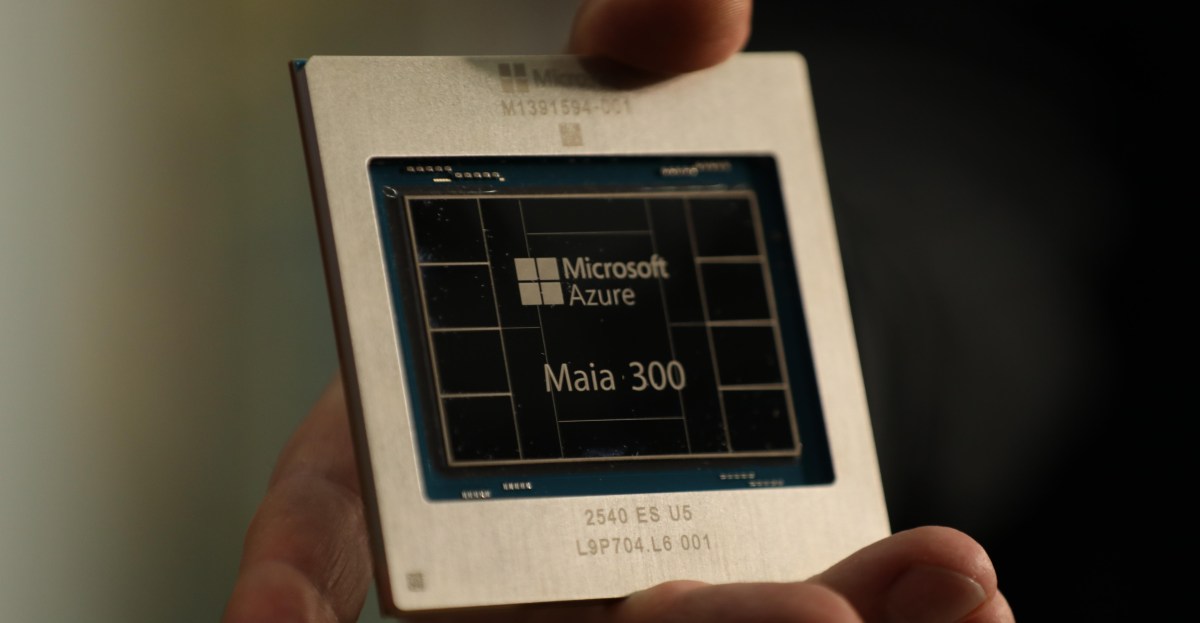
Microsoft announced the Maia 300, its third-generation in-house AI chip, positioning it as the future "primary AI inference system" for Microsoft products and services. The company says the new silicon is built for the reasoning models and agentic workloads that now dominate cloud AI traffic.
The chip marks a clear strategic shift: Microsoft wants to run most of its AI inference on hardware it designs itself rather than on GPUs from Nvidia and AMD. Maia 300 will begin rolling out to production AI workloads in 2027, according to Microsoft, with multi-gigawatt Azure deployments planned from that year onward.
Maia 300 specs and efficiency claims
Microsoft is leaning hard on efficiency, the metric that matters most when AI inference costs are measured in megawatts. The company quotes a major gain over GPU-based systems, and an even larger jump over its own previous generation in dense rack configurations.
The Maia 300 uses a chiplet architecture built on TSMC's N2P process node, separating compute, memory controller and I/O functions so each part can use the technology best suited to its role. Microsoft's Azure hardware team says this raises the silicon area dedicated to compute performance.
- 40 percent more tokens per megawatt than leading GPU-based systems, per Microsoft
- Up to 7x the rack-scale token throughput of Maia 200 in a full 96-accelerator configuration
- Chiplet design on TSMC's N2P process node
- Compute, memory controller and I/O separated into distinct functions