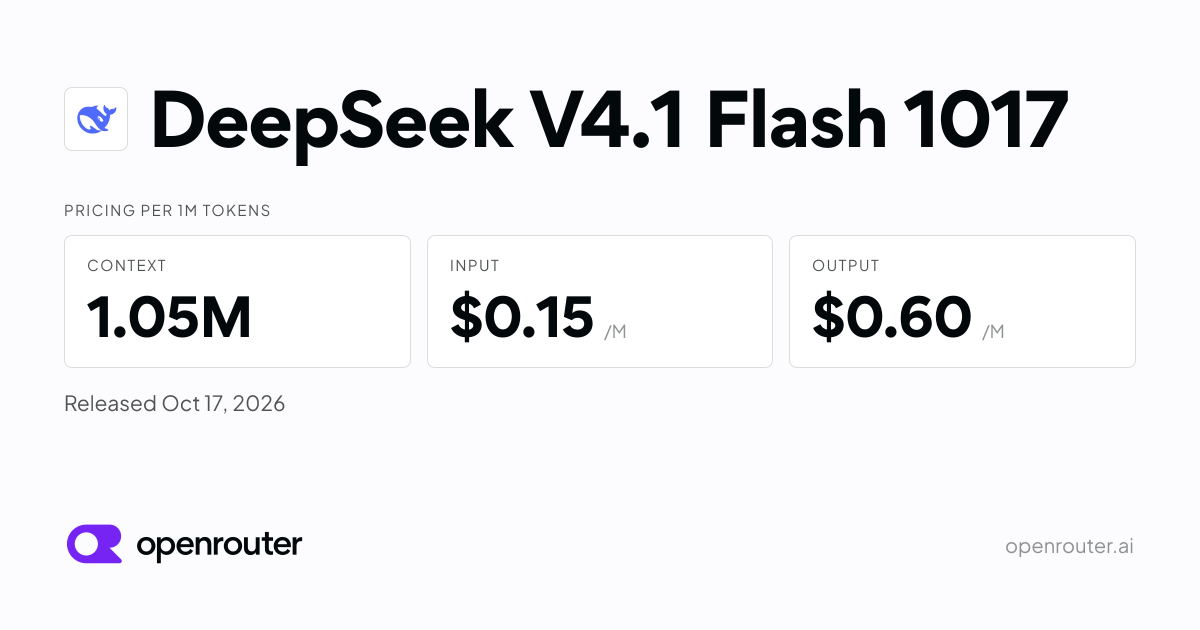
DeepSeek has released DeepSeek V4.1 Flash 1017, the October 17, 2026 snapshot of its Flash model, now available through the company's website, app and API, where it is served under the `deepseek-flash` model name on OpenRouter. The company also published the model weights as open source on Hugging Face and ModelScope.
According to The Decoder, the update delivers better benchmark scores, finishes tasks faster and produces shorter outputs than its direct predecessor. DeepSeek calls it a Pareto improvement in the tradeoff between performance and cost — a claim that matters as the global AI race shifts toward cheap, fast models built for agents and coding.
What DeepSeek V4.1 Flash 1017 can do
DeepSeek says the model was tuned for development environments including DeepSeek Harness (version v0.2.1-rc.1 or later recommended), Tencent CodeBuddy and WorkBuddy. For building complete software projects from scratch, the company uses reinforcement learning with self-feedback, or RLSF.
That post-training method lets the model use its own internal confidence scores or self-generated critiques as a reward signal, removing the need for human evaluators or external reward models. DeepSeek says this improves end-to-end project development, from game programming to 3D modeling and design work, and that the model can animate compact explainer videos, similar to the recently released Opus 5.5.
- Better benchmark scores, faster task completion and shorter outputs than V4.1-Flash, per DeepSeek.
- In DeepSeek's own benchmarks, it beats larger models including Claude Opus 5, GPT 5.6-Sol, Kimi K3 and GLM 5.3 in several coding and AI agent categories.
- DeepSWE benchmark: a top score of 77.0 percent at an average cost of just under $0.20 per task.